
 By Global Arena
Most homeowners sign a hardscaping contract before realizing their contractor plans to lay a premium patio on a sub-par gravel base. You are paying thousands for materials, so why risk having your entire investment sink after the first winter freeze?
I have spent over a decade on my knees laying patios, driveways, and walkways. I have seen exactly what happens when you pair expensive stones with cheap labor, and I have torn up plenty of five-year-old patios that looked like rollercoasters because the foundation was ignored. Bkstone has become a massively popular choice for homeowners who want the aesthetic of high-end natural stone with the structural predictability of a manufactured paver. But buying the material is only ten percent of the job.
If you are planning to upgrade your outdoor living space this year, you need to understand how these pavers actually work in the dirt. Contractors will throw industry jargon at you during the estimate phase. This guide gives you the specific knowledge you need to call their bluff, protect your budget, and guarantee a result that survives the next decade of harsh weather.
1. Why Bkstone Outperforms Standard Concrete
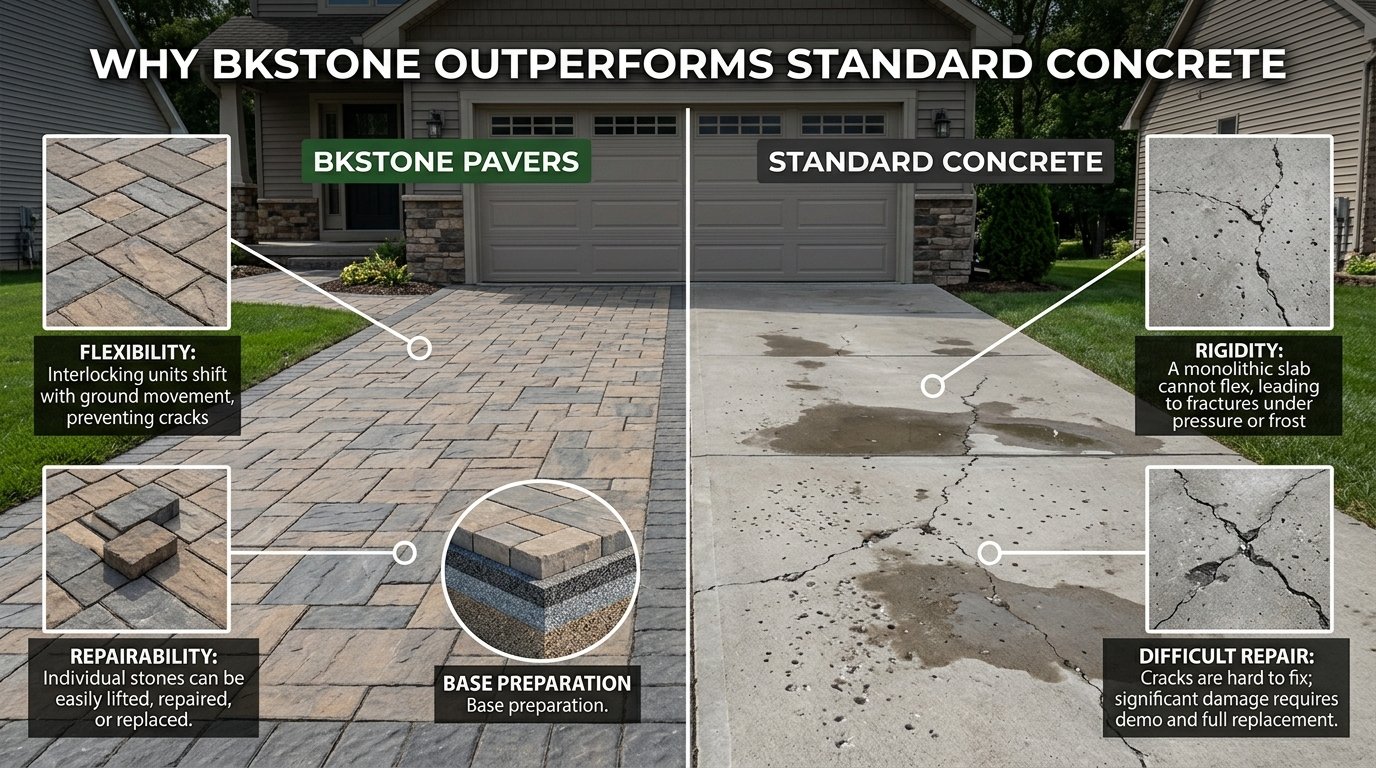
Standard stamped concrete is cheap, fast, and guaranteed to crack. It is not a matter of if, but when. The ground beneath our feet constantly moves, freezes, thaws, and shifts. A giant rigid slab of concrete cannot flex with the earth.
Bkstone solves this exact problem through modular flexibility. Because the surface is made of individual high-density paving units separated by sand joints, the entire patio can flex slightly as the ground shifts. If a severe freeze heaves a section of your walkway, you do not need a jackhammer to fix it. You simply pull up the affected pavers, re-level the base material, and lay the exact same stones back down.
These pavers also boast a significantly higher compressive strength than poured concrete. A typical residential concrete driveway can handle about 3,000 to 4,000 PSI (pounds per square inch). Premium paving units like these are manufactured in controlled environments using extreme pressure and vibration, often resulting in a density that withstands 8,000 PSI or more. This means they are far less likely to chip under the weight of a heavy truck or crack when you drop a cast-iron grill grate on your patio.
The manufacturing process mixes color pigments throughout the entire stone, rather than just painting a thin layer on top. If a stone gets slightly scratched over the years, the color remains consistent. You are getting a product designed for heavy utility, dressed up to look like luxury masonry.
2. Material Matchup: Bkstone vs. The Alternatives
You probably have a few tabs open right now comparing different hardscaping materials. Let us strip away the marketing fluff and look at how they actually perform in a residential backyard. Have you actually tested your soil drainage before asking for a quote? If you have pooling water, your material choice matters even more.
| Feature | Poured Concrete | Natural Flagstone | Bkstone |
| Flexibility | Zero. Cracks under ground pressure. | High, but stones can flake or snap. | High. Interlocking system flexes safely. |
| Installation Speed | Very fast. Usually done in 2 days. | Extremely slow. Requires custom cutting. | Moderate. Requires precision base prep. |
| Color Consistency | Fades heavily. Hard to match repairs. | Varies wildly by pallet (natural variance). | Highly consistent batch to batch. |
| Surface Temperature | Moderate heat retention. | Can get dangerously hot in direct sun. | Moderate. Lighter colors stay cool. |
| Cost to Repair | High. Requires demolition. | Moderate. Finding matching stone is hard. | Low. Lift and relay the existing units. |
Flagstone is gorgeous, but installing it is a nightmare. A mason has to chisel and fit every single piece like a chaotic jigsaw puzzle, which drives your labor costs through the roof. Bkstone provides the aesthetic texture of that natural stone but with precise, uniform dimensions. That uniformity speeds up the installation process and cuts down on expensive mason hours.
3. The True Cost of a Bkstone Installation
Let us talk numbers. A major mistake people make is looking at the price per square foot of the paver at a supply yard and assuming that is the cost of their patio. The physical stone usually only accounts for about 20% to 30% of your total invoice.
Here is a real-world scenario. Let us say you want a 400-square-foot patio. The Bkstone units might cost $6 per square foot at the supply yard, totaling $2,400. You might think a $5,000 budget will cover the whole project. You would be dead wrong.
To build that patio correctly, a crew needs to excavate and haul away roughly 15 tons of dirt. Then they need to buy, deliver, and install 15 tons of crushed gravel for the base, plus a ton of concrete sand, edge restraints, spikes, and specialized polymeric joint sand. Add in the cost of labor, equipment wear and tear, and the contractor’s overhead, and that $2,400 stack of stones easily turns into an $8,000 to $12,000 final invoice.
If a contractor bids that 400-square-foot job for $4,000, run away. They are either skipping the excavation, using cheap dirt instead of crushed gravel for the base, or they have no insurance. Paying a cut-rate price now guarantees you will pay full price in three years to have a real professional rip it out and do it over.
4. Spotting a Bad Bkstone Contractor Before They Start
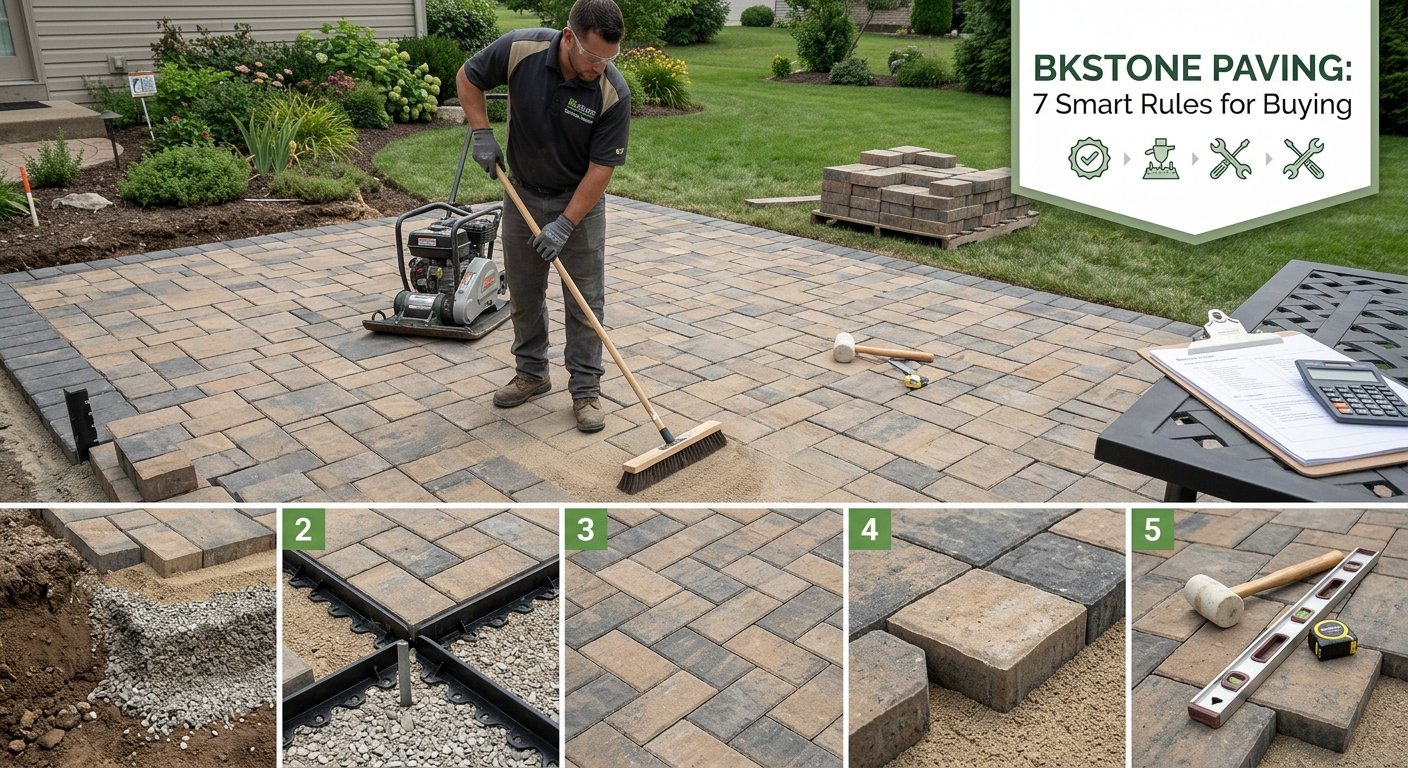
The secret to a permanent patio is entirely invisible once the job is finished. The base preparation dictates the lifespan of your project. If you want to know if your contractor actually knows what they are doing, ask them to explain their base installation process.
First, they need to over-dig. If your patio is going to be 15 feet wide, the excavated hole needs to be at least 16 feet wide. The gravel base must extend past the edge of the paved surface by at least six inches on all sides. Without this extension, the pavers on the perimeter will eventually roll off the edge and separate from the main patio.
Next, ask about geotextile fabric. A good hardscaper will line the bottom of the excavated dirt hole with a woven geotextile fabric before dumping the gravel in. This fabric prevents the native soil from mixing with your clean gravel over time. If they skip the fabric, your gravel base will eventually sink into the mud, taking your expensive stones down with it.
For a pedestrian patio, you need a minimum of four to six inches of compacted crushed stone base. For a driveway, you need ten to twelve inches. They cannot just dump six inches of gravel into a hole and run a compactor over it once. The gravel must be installed and compacted in “lifts” of two inches at a time. If they try to compact six inches of gravel all at once, the bottom four inches remain loose.
Finally, check their edge restraints. They should be using either an invisible poured concrete mortar bead hidden under the soil or heavy-duty plastic edge restraints secured with 10-inch steel spikes driven into the compacted base. If they try to spike the edge restraint into loose topsoil, your Bkstone installation will spread apart within six months.
5. Nailing the Color Blend and Pattern
Choosing the color of your stones is highly subjective, but the way those colors are installed requires strict mechanical rules. Most premium pavers feature a blended color palette—meaning each stone has a mix of two or three tones.
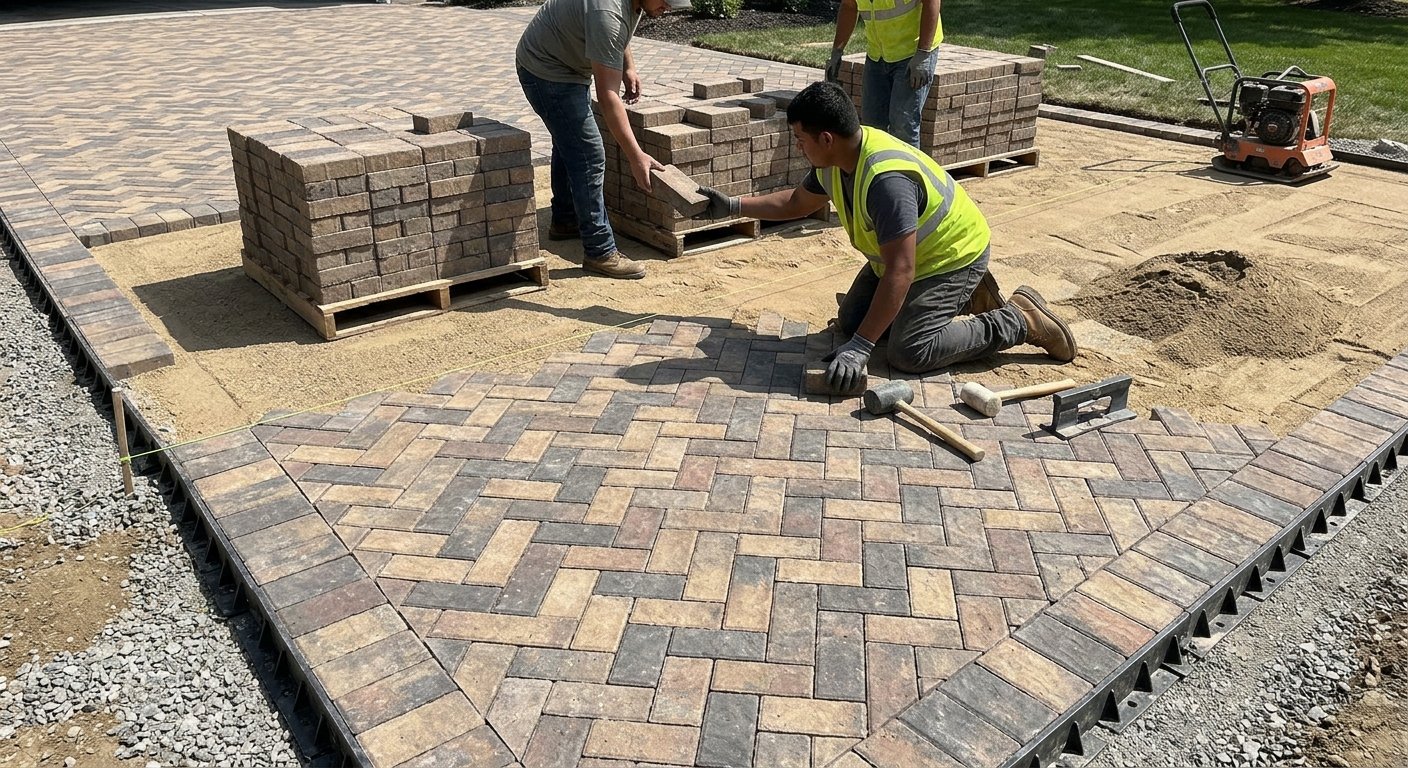
When a contractor arrives with five pallets of stone, they must not lay one full pallet, then start the next. Pavers are manufactured in batches. Even with strict quality control, pallet number one might be slightly darker than pallet number five. If the crew does not blend the materials, your finished patio will have a giant dark patch on one side and a light patch on the other. A professional crew will open all five pallets immediately and pull stones from each one simultaneously, ensuring a completely randomized, natural color blend across the entire surface.
You also need to think about laying patterns.
- Running Bond: Simple, linear, and creates clean sightlines. Great for modern homes.
- Herringbone: Stones are interlocked at 45 or 90-degree angles.
- Ashlar: A randomized mix of multiple stone sizes to mimic historic European streets.
For driveways, you must use a herringbone pattern. Vehicles turning their wheels create immense rotational torque. A running bond pattern cannot resist that torque, and the tires will eventually push the stones out of alignment. A herringbone pattern interlocks the stones so deeply that rotational torque is distributed across the entire driveway, keeping every piece exactly where it belongs.
Be aware that complex patterns require more cutting. If you choose a 45-degree herringbone pattern, the crew has to cut every single stone that touches the perimeter of the patio. You must factor in an extra 15% to your material order just to account for the waste generated by these cuts.
6. Long-Term Maintenance for Patios
Sales reps love to claim that paving stones are maintenance-free. That is a lie. They are low-maintenance, but you still have to put in work to keep them looking pristine. Are you willing to re-sand the joints every five years to keep weeds out?
The biggest initial headache you will face is efflorescence. About a month after your patio is installed, you might walk outside and see a chalky white haze covering the surface of your beautiful new Bkstone. Do not panic, and do not blame your contractor. This is a natural chemical reaction. Moisture inside the concrete carries calcium hydroxide to the surface. When it meets the carbon dioxide in the air, it turns into calcium carbonate—a white powder.
Do not try to scrub efflorescence away with a wire brush, as you will permanently scratch the stones. Let the patio sit exposed to the weather for a few months. Rain and natural weathering often wash it away. If it persists after a year, you can buy a specialized efflorescence cleaner that safely dissolves the minerals without bleaching the pigment.
You also need to protect the polymeric sand in the joints. This sand acts as a flexible glue, hardening to keep weeds out and locking the stones tightly together. Never hit your patio joints with a zero-degree power washer nozzle. You will blast the expensive sand right out of the gaps. Use a wide fan tip, keep the wand twelve inches away from the surface, and wash at an angle.
Should you seal the surface? It depends on your lifestyle. Sealing is not structurally necessary, but it acts like a Teflon coating against stains. If your patio sits under a messy oak tree that drops leaves and acorns, or if you barbecue constantly and worry about grease splatters, a penetrating sealer is a smart investment. You must wait at least 90 days after installation before applying any sealer. If you seal it too early, you will trap that chalky efflorescence under a layer of acrylic, and you will have to strip the entire patio with harsh chemicals to fix it.
7. When to Walk Away from an Estimate
Negotiating hardscaping contracts requires a sharp eye for omissions. Some contractors intentionally leave crucial steps out of their written estimates to keep the initial price low, planning to hit you with change orders later.
If the estimate simply says “Install patio,” hand it back. A professional quote will break down the exact square footage, the depth of the excavation, the specific tonnage and type of base gravel, the brand of polymeric sand, and the specific model of Bkstone you agreed upon.
Watch out for the word “stone dust.” Some old-school contractors still use limestone dust as their bedding layer (the one-inch layer directly under the pavers). Stone dust holds moisture and traps water directly under the pavers, which leads to massive frost heave in the winter. The industry standard is one inch of coarse, washed concrete sand. If a contractor argues with you about using concrete sand over stone dust, end the conversation and find someone else.
Pay attention to how they handle drainage. A patio should never be perfectly flat. It must slope away from your house foundation at a minimum pitch of one-quarter inch per foot. Ask the contractor to show you where the water is going to go. If they just point vaguely toward the back of the yard without assessing the actual grade, you are going to end up with a swamp for a lawn.
Frequently Asked Questions About Bkstone
Does the surface get dangerously hot in the summer?
Like any masonry product, darker colors will absorb and retain more heat than lighter colors. However, these pavers do not generally reach the skin-burning temperatures of solid asphalt or poured dark concrete. If your patio gets relentless direct afternoon sun, opt for a blended color palette featuring tans or light grays to keep the surface comfortable for bare feet.
Can I install these pavers over an existing concrete slab?
Yes, it is called an overlay, but it requires specific conditions. The existing concrete slab must be structurally sound without major heaving or wide cracks. The contractor must drill drainage weep holes through the concrete, add a layer of bedding sand or drainage mat, and then lay the Bkstone. Be aware that adding pavers on top of an existing slab raises the patio height by about three inches, which can interfere with door thresholds or step heights.
Will salt melt ice without damaging the surface?
You can use de-icing products, but you must avoid pure rock salt (sodium chloride). Rock salt causes extreme freeze-thaw cycles on the surface that can eventually cause the concrete to pit and scale. Instead, use a calcium magnesium acetate (CMA) based de-icer, which melts ice effectively without eating away at the density of your paving stones. Always sweep up leftover de-icer once the ice has melted.
How long does a typical installation take?
A standard 400-square-foot residential patio usually takes a professional three-person crew about four to five days to complete from excavation to final cleanup. Weather, limited access to the backyard (like narrow fence gates that prevent machinery access), and complex cutting patterns can extend this timeline by several days.
Conclusion
Investing in a hardscaped outdoor living area fundamentally changes how you use your home, provided the engineering underneath the surface matches the beauty on top. You now know the specific rules for base depths, edge restraints, and material blending that separate amateur jobs from permanent architecture. The aesthetic appeal of Bkstone is undeniable, but its true value is unlocked when paired with an uncompromising, professional installation process. Before you schedule any contractor meetings, go to your backyard right now, hammer a wooden stake into the ground where you want the patio to end, and run a string line back to your house to visualize the exact scale and slope of your future space.